
Reducing risk in new product launches. How to approach testing and implementation?
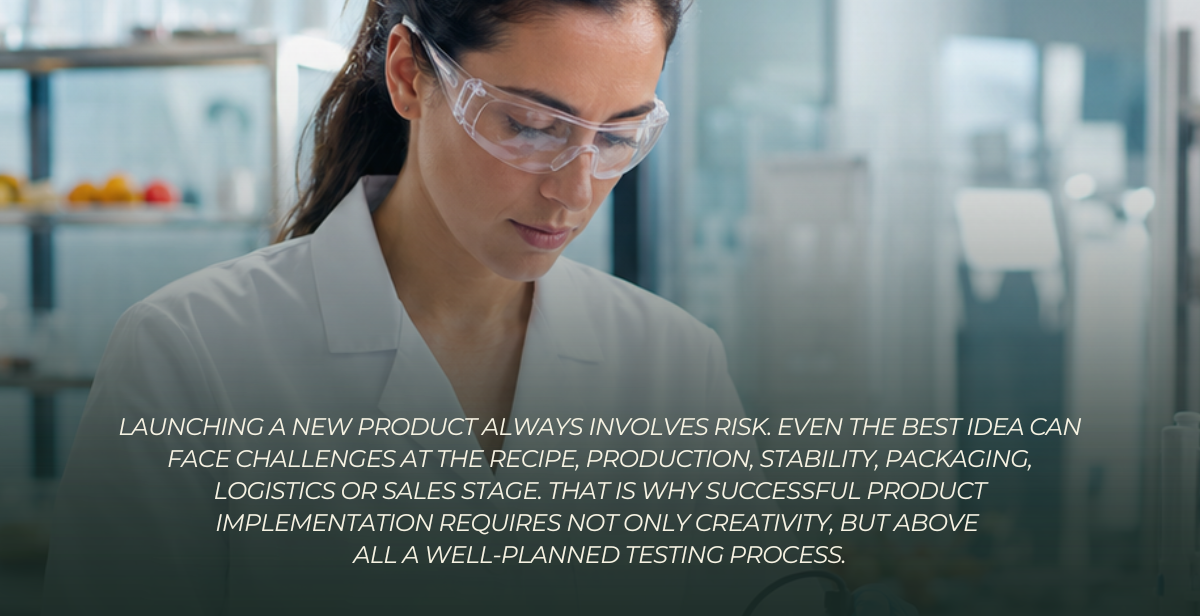
Launching a new product always involves risk. Even the best idea can face challenges at the recipe, production, stability, packaging, logistics or sales stage. That is why successful product implementation requires not only creativity, but above all a well-planned testing process.
In the food industry, it is especially important that a new product is not only attractive to consumers, but also stable, repeatable, safe and scalable for larger production. The right approach to testing helps reduce the risk of costly mistakes and increases the chances of a successful market launch.
Why is testing so important?
Testing helps verify whether a product concept works in practice. At an early stage, it is possible to evaluate taste, texture, appearance, ingredient functionality and the reaction of potential customers.
This is the moment when changes can still be made without generating high production costs. The earlier problems are identified, the easier they are to solve. This applies to the recipe, technological process, packaging and marketing communication.
Well-planned testing helps answer key questions: does the product meet the original assumptions? Is it stable? Do consumers like its taste? Can it be produced at scale? Does it maintain quality throughout its entire shelf life?
From laboratory trials to pilot production
The first stage usually involves laboratory or kitchen trials. This is where the first versions of the recipe are created. At this level, ingredients, proportions, taste, consistency, color and the basic functionality of the product are tested.
The next step is pilot production. This is a very important moment because it allows manufacturers to check whether the recipe works not only on a small scale, but also in conditions close to real production.
Many products behave differently on a production line than they do in the laboratory. Differences may appear in texture, stability, mixing, heat treatment, packaging or process efficiency. Pilot production helps identify these issues before full-scale production begins.
Sensory testing and consumer feedback
A food product must first and foremost be attractive to the end consumer. That is why sensory testing is one of the most important elements of the implementation process.
During sensory testing, taste, aroma, appearance, texture, color, sweetness level, aroma intensity and the overall eating experience are assessed. It is worth testing the product both internally within the project team and externally with potential consumers.
Consumer feedback can show whether the product is understandable, attractive and aligned with market expectations. Sometimes a small change in the recipe, packaging communication or serving method can significantly improve how the product is perceived.
Stability and shelf life
One of the key areas of risk is product stability. Even if a product tastes good immediately after production, it must maintain the right quality throughout the declared shelf life.
Stability testing helps assess how the product behaves over time. This includes checking taste, aroma, color, texture, phase separation, moisture, structure, water activity and resistance to changing storage conditions.
In plant-based products, factors such as emulsion stability, protein behavior, fiber impact, ingredient interactions and the product’s response to heat treatment or freezing may be particularly important.
Thanks to stability testing, manufacturers can better define shelf life, select the right packaging and avoid quality problems after the product enters the market.
Recipe scaling
Scaling is one of the most demanding stages of product implementation. A recipe developed on a small scale does not always work in exactly the same way in industrial production.
A change in scale affects mixing, processing time, temperature, viscosity, aeration, structure and product repeatability. That is why it is important to test the product on equipment that is as close as possible to the machinery used in the target production process.
At this stage, adjustments to the recipe or process parameters are often necessary. The goal is to obtain a product that is stable, repeatable and cost-effective to produce.
Packaging and logistics
The risks connected with a new product do not end with the recipe. Packaging has a major impact on product quality, shelf life, safety and attractiveness.
It is worth checking whether the packaging protects the product properly, is convenient for consumers, is suitable for transport and storage, and supports the declared shelf life.
Logistics testing helps assess how the product behaves during transport, temperature changes, palletizing or in-store display. This helps reduce the risk of damage, complaints and losses.
Step-by-Step implementation
The safest approach to launching a new product is a staged implementation. Instead of immediately starting large-scale production and wide distribution, it is often better to begin with a smaller test batch.
This model makes it possible to collect initial sales data, consumer opinions, buyer feedback and market insights. Based on this information, final improvements can be introduced before a larger launch.
A staged implementation reduces financial and operational risk. It also helps better adapt the product to market expectations before it is widely introduced to sales channels.
How to reduce risk?
The risk of launching a new product can be reduced through a well-planned process. Key elements include a clear concept, proper ingredient selection, laboratory testing, pilot production, sensory testing, stability analysis, packaging verification and staged implementation.
Cooperation with experienced partners is also important – especially partners who understand the specific nature of ingredients, technological processes and market requirements. The right support at an early stage can help avoid mistakes that later become costly and difficult to fix.
Safer product launches with the right support
Every new product involves some level of uncertainty. Risk cannot be eliminated completely, but it can be significantly reduced through testing, analysis and a step-by-step approach to implementation.
A well-prepared process allows decisions to be made based on data, not only intuition. As a result, the product has a better chance not only to reach the shelf, but also to stay there longer.
Vegan Stock can support manufacturers at various stages of the implementation process – from selecting the right plant-based ingredients, through support in R&D and testing, to preparing the product for production and sales. With market knowledge and a broad portfolio of ingredients, Vegan Stock helps reduce risk and guide new products more effectively from concept to implementation.
Click and join our newsletter
The best for you
Reach us out
Vegan Stock sp. z o.o.
address:
6, Józefa Marcika Str,
30-443 Kraków, Poland
Tax ID No. PL7352876025