
Plant-Based ingredients in traditional food - more than just plant-based alternatives
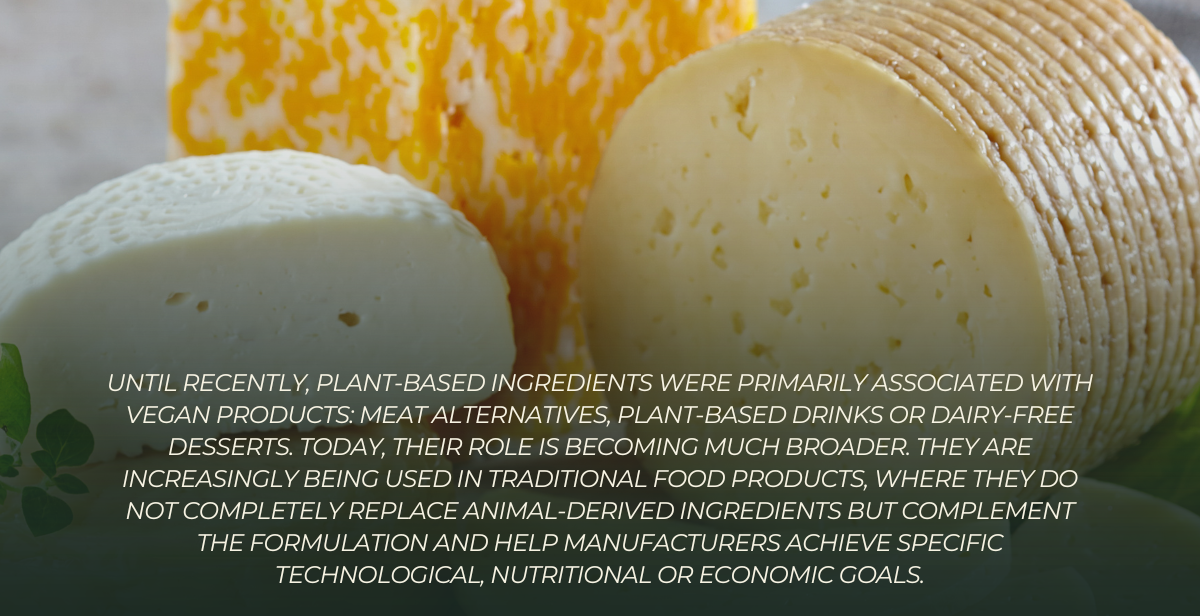
Until recently, plant-based ingredients were primarily associated with vegan products: meat alternatives, plant-based drinks or dairy-free desserts. Today, their role is becoming much broader. They are increasingly being used in traditional food products, where they do not completely replace animal-derived ingredients but complement the formulation and help manufacturers achieve specific technological, nutritional or economic goals.
This represents an important change in how we think about the plant-based market. Plant-based ingredients are no longer reserved for a single group of consumers. They are becoming valuable tools used by R&D teams to develop entire product portfolios.
Not every product containing plant-based ingredients has to be vegan
Adding pea protein to a snack, oat fibre to a baked product or a coconut-based ingredient to a sauce does not automatically turn it into a plant-based alternative. These raw materials can simply be selected as components of the formulation because of their specific properties.
This approach creates significantly more opportunities for manufacturers. Instead of developing a completely new product category, they can improve products that consumers already know and buy. The changes may relate to nutritional value, texture, stability, flavour, positioning or production costs.
As a result, plant-based ingredients are becoming part of the food industry’s mainstream rather than merely addressing the needs of consumers following a vegan diet.
Function is more important than the label
In modern product development, the most important question should not be: “How can we add a plant-based ingredient?” It should be: “What problem do we want this ingredient to solve?”
Plant-based ingredients can perform a variety of functions in a formulation: increase protein or fibre content, influence thickness and viscosity, support water binding, help create the desired structure, provide creaminess, enhance flavour and aroma, improve the product’s satiating properties, reduce the proportion of selected raw materials, enable the development of new recipe variants.
For example, a plant protein may be added not to replace every other protein source but to increase the product’s total protein content. A coconut-based ingredient may provide texture and flavour, while fibre can support the product’s structure or enable the use of a specific nutrition claim.
What matters is therefore not simply the presence of a plant-based raw material but its actual contribution to the final product.
Traditional formulations do not have to remain unchanged
Consumers are attached to familiar tastes and formats. At the same time, they increasingly pay attention to ingredient lists, protein and fibre content, and the proportion of plant-derived ingredients.
For manufacturers, this creates an opportunity to gradually develop existing products without completely redesigning them. Even a limited formulation change can lead to a new version of a familiar product or help align it more closely with current consumer expectations.
Such an approach may be easier for consumers to accept than an entirely new alternative. The product retains its basic identity, flavour and method of use while gaining additional value.
Plant-based as a component, not necessarily the main message
The presence of a plant-based ingredient does not always have to become the central element of a product’s marketing communication. For some consumers, specific benefits such as high protein content, a source of fibre, creamy texture, interesting flavour or a convenient format will be more persuasive.
A plant-based ingredient can therefore work in the background. It helps build the product but does not have to determine its entire positioning.
This is particularly important for consumers who do not identify as vegan or vegetarian. They may still be willing to choose products containing more plant-derived ingredients if they are satisfied with the taste, price, composition and functionality.
This allows manufacturers to reach a much broader market rather than focusing exclusively on a narrow consumer group.
Flexitarians are changing the way products are designed
The growth of flexitarianism shows that consumer choices are not always binary. Many people do not want to eliminate meat, dairy or eggs completely but are consciously increasing the proportion of plant-based foods in their diets.
From the food industry’s perspective, this creates room for products combining different sources of raw materials. They can contain both animal-derived and plant-based ingredients without having to position themselves entirely on one side.
These formulations enable manufacturers to create more flexible solutions that fit consumers’ everyday habits rather than strictly defined diets.
One example is meat products containing additional proteins, vegetables, mushrooms or pulses. Their purpose does not always have to be to imitate vegan food. They can simply offer a lower proportion of meat, a more diverse formulation or a new sensory profile.
An opportunity to optimise the formulation
Plant-based ingredients can also help manufacturers respond to price volatility, raw material availability issues and the need to improve production profitability. Their use may reduce the proportion of selected ingredients, increase recipe efficiency or take advantage of their water-binding and structure-building properties.
However, this does not mean that every plant-based ingredient will automatically reduce the cost of the final product. Its required dosage, influence on the production process and the possible need for additional ingredients must also be considered.
Real profitability should be assessed across the entire formulation. The analysis should consider: raw material costs, production efficiency, processing time and methods, product stability, potential losses, shelf life, final sensory quality.
A well-selected ingredient can help optimise costs and increase margins. A poorly matched one may create additional technological challenges.
Sensory quality remains the greatest challenge
Consumers may be interested in higher levels of protein, fibre or plant-based ingredients, but taste usually determines whether they purchase the product again.
Plant proteins and flours can affect aroma, colour, texture and mouthfeel. Some increase viscosity, while others may cause dryness, sedimentation or a distinctive aftertaste. The final result depends not only on the type of raw material but also on its quality, parameters, dosage and interaction with the remaining ingredients.
It is therefore not enough to select a protein solely on the basis of its protein percentage. Pea protein may work best in one application, while rice, oat, fava bean, hemp or almond protein may be more suitable in another. In some cases, combining several sources will deliver the best result.
The same applies to other ingredients. A raw material that performs well in a baked product may not behave equally well in a drink, sauce or frozen application.
The ingredient must be matched to the process
The entire production process must be considered when selecting a raw material. Temperature, pH, order of addition, mixing intensity, homogenisation, fermentation, pasteurisation, freezing and storage conditions can all influence its performance.
A plant-based ingredient may behave correctly in an initial laboratory sample but perform differently when production is scaled up. It may alter viscosity, cause sedimentation, affect aeration or interact with other elements of the formulation.
For this reason, the implementation process should include technological trials, sensory testing and stability assessment. Labelling requirements, allergens and the possibility of using nutrition claims must also be carefully verified.
A new perspective on plant-based ingredients
Plant-based ingredients are no longer merely the basis for meat and dairy alternatives. They can become part of almost every modern food product development strategy.
Their role may be highly visible and form the foundation of the product’s communication. It may also remain almost unnoticeable to consumers while still being essential to the product’s texture, nutritional value, stability or formulation cost.
The greatest opportunity does not always lie in completely replacing traditional products. It can often be found in gradually improving them by intelligently combining different raw material sources and using their most valuable properties. This may define the next stage of the plant-based market: moving beyond the imitation of familiar foods towards the creation of better, more flexible and thoughtfully designed formulations.
If you are unsure which plant-based ingredients will perform best in your product, contact the Vegan Stock team. For years, we have supported food manufacturers in selecting suitable raw materials and advised them on new ideas, projects and technological solutions for plant-based, traditional and hybrid products.
Click and join our newsletter
The best for you
Reach us out
Vegan Stock sp. z o.o.
address:
6, Józefa Marcika Str,
30-443 Kraków, Poland
Tax ID No. PL7352876025