
Fat in plant-based meat alternatives: a carrier of flavour, juiciness and texture
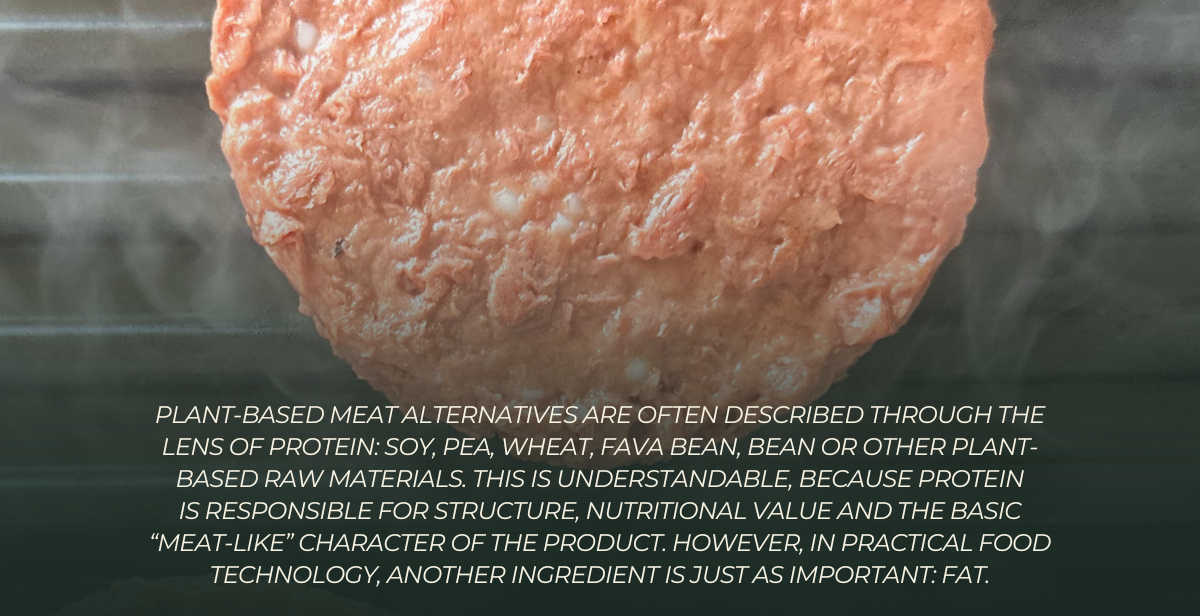
Plant-based meat alternatives are often described through the lens of protein: soy, pea, wheat, fava bean, bean or other plant-based raw materials. This is understandable, because protein is responsible for structure, nutritional value and the basic “meat-like” character of the product. However, in practical food technology, another ingredient is just as important: fat.
It is fat that largely determines whether a burger is juicy, whether a sausage sizzles pleasantly in the pan, whether pieces of plant-based “chicken” remain moist after heat treatment, and whether the finished product gives a sense of fullness, softness and satisfaction in the mouth. In traditional meat, fat is not a secondary addition. It co-creates flavour, aroma, texture, tenderness and the perception of juiciness. That is why, in plant-based meat alternatives, its role is much more complex than simply “increasing the caloric value” of the product.
Fat as a flavour carrier
The flavour of meat does not come from protein alone. Fat-soluble aromatic compounds and the reactions that occur during frying, baking or grilling also play a major role. Fat acts as a carrier of aroma: it carries notes of spices, umami, smoke, roasting, herbs or fermented ingredients. As a result, the product’s flavour becomes more rounded and lingers longer in the mouth.
This is particularly important in plant-based meat alternatives, because plant proteins themselves can have their own characteristic notes: legume-like, cereal-like, slightly bitter or earthy. A well-selected fat phase helps to balance them. It is not about masking the quality of the raw material, but about building a fuller sensory profile.
That is why formulating plant-based meat requires recreating the entire consumer experience, not only the nutritional value of meat. Flavour, stability, texture and familiarity in everyday cooking all matter.
Juiciness: why protein alone is not enough
One of the biggest challenges in producing plant-based meat alternatives is avoiding dryness. A product may have good protein content, an interesting flavour and an attractive appearance, but if it is dry, crumbly or “rubbery” after frying, the consumer will quickly notice.
In animal meat, juiciness results from the combination of water, fat, the structure of muscle fibres and the way fat is distributed throughout the tissue. In plant-based products, this effect has to be designed from scratch. Fat should not only be present in the recipe, but should also behave properly during heat treatment.
If fat leaks out too quickly, the product may become dry. If it remains too hard, it does not create a sense of juiciness. If its melting point is poorly selected, the consumer may perceive waxiness, heaviness or artificiality in the mouth.
That is why plant-based meat technology increasingly focuses not only on which fat to use, but also on how to organise it within the product. Research on meat analogues indicates that fat is responsible for texture, flavour, mouthfeel and juiciness in meat products, and recreating these functions is one of the key challenges in the plant-based category.
Texture: fat as a structural element
In a good plant-based burger, minced product, sausage or strips, flavour is not the only thing that matters – texture is equally important. Consumers expect a product with the right bite resistance, one that does not fall apart in the pan, is not a dry protein mass and does not resemble a paste.
Fat influences texture in several ways.
First, it gives the product softness and tenderness. Without it, a structure based mainly on protein and fibre may be too dense. Second, it facilitates a sense of “lubrication” in the mouth, which is perceived as juiciness and fullness. Third, in minced products, it can create visible or perceptible “fat pockets” that resemble the marbling of meat.
This is especially important in premium products. Consumers judge them not only by their ingredient list, but by the whole experience: how the product looks before frying, how it smells in the pan, whether it browns, whether it sizzles and whether it remains juicy a few minutes after preparation.
In the case of whole-cut meat alternatives, such as plant-based steaks, fillets or chicken-inspired pieces, the challenge is even more complex. It is necessary to design not only the protein structure, but also the way fat is distributed, so that it resembles natural marbling and creates juiciness during eating. Intramuscular fat marbling affects juiciness and flavour fullness, and recreating it in a stable way in plant-based products remains an important challenge.
Not every fat works in the same way
Different fat sources are used in plant-based meat alternative recipes, including rapeseed oil, sunflower oil, coconut oil, shea fat, cocoa butter, and blends of oils and structured fats. Each of them has different properties: flavour, melting point, oxidative stability, fatty acid profile and impact on texture.
Coconut fat is popular because it can be solid at room temperature and melts during heat treatment, creating a juicy effect. However, it has limitations: it may melt too quickly, affect the saturated fat profile and does not always accurately reproduce the behaviour of animal fat. Simply adding coconut oil is not enough to faithfully replace the functions of animal fat in meat analogues.
Liquid oils such as rapeseed or sunflower oil may be more favourable in terms of their unsaturated fatty acid profile, but they require technological “encapsulation” within the product structure. Otherwise, they may leak out during frying, weaken the texture or reduce product stability.
That is why fat structuring technologies are becoming increasingly important: emulsions, emulsion gels, oleogels, and systems based on proteins, polysaccharides or fibres. Their aim is to obtain fat that behaves more like adipose tissue: stable in the product, melting at the right moment, providing juiciness and improving mouthfeel. Combining different oils can also be a good solution, for example coconut oil with rapeseed oil. Coconut oil helps build structure and a melting effect, while rapeseed oil can improve the nutritional profile of the product and provide a more neutral, well-accepted flavour character.
Oleogels and structured fats: a direction for category development
One of the most promising directions is oleogels, systems in which liquid oil is “solidified” with the help of appropriate structuring substances. This makes it possible to use oils with a more favourable nutritional profile while giving them the properties of solid fat.
This matters for two reasons. First, producers can reduce the share of saturated fats without losing sensory functionality. Second, it allows for more precise control of texture, melting and aroma release.
Oleogels are being studied as an alternative to animal fats because they can improve the nutritional profile of products while maintaining desirable technological and sensory properties. In adipose tissue analogues, oleogels and emulsion gels may mimic the behaviour of animal fat better than simply adding plant-based fat.
Fat and clean label
In the plant-based meat alternatives category, not only flavour but also simplicity and ingredient transparency are becoming increasingly important. Consumers want tasty products, but they also pay attention to the length of the ingredient list, the type of fats used, and the content of salt, protein and saturated fats.
This creates a technological tension. On the one hand, the product should be juicy, aromatic and resistant to heat treatment. On the other hand, it should not feel overly processed. That is why producers are looking for solutions that combine functionality with an acceptable ingredient list: oils familiar to consumers, plant fibres, plant proteins, starches, natural flavourings, yeast extracts or fermented ingredients that build umami.
In practice, a good fat in a plant-based meat alternative must perform several functions at once: improve flavour, increase juiciness, support texture, remain stable during production and frying, look good on the label and meet consumers’ nutritional expectations.
The impact of fat on the culinary experience
A plant-based meat alternative does not exist in a vacuum. Consumers prepare it in a pan, on a grill or in the oven. Fat influences each of these moments.
During frying, it is responsible for sizzling, browning, aroma and the impression of “cooking like meat”. In a burger, it helps maintain juiciness between the bun, vegetables and sauce. In plant-based kebab, gyros or strips, it protects the product from drying out. In sausages, it affects springiness, a juicy bite and the feeling of fullness after biting.
That is why products with similar protein content can be perceived very differently. One may be dry and floury, while another is juicy and satisfying. The difference often lies not only in the protein source, but in the entire formulation system: the proportions of water, protein, fibre, fat, aromas and the technology used to combine them.
Fat as an element of premiumisation
In the plant-based meat alternatives segment, the division between basic and premium products is becoming increasingly visible. Premium products do not compete only on price. They compete through experience: flavour, texture, appearance, ingredient quality and consistency after preparation.
In this context, fat is one of the most important tools of premiumisation. It can distinguish a merely “acceptable” product from one consumers return to. A juicy burger that remains soft after frying. A plant-based chicken alternative that does not dry out in a dish. A sausage with a pleasant snap, aroma and fattiness similar to a classic product, but without animal-derived ingredients.
A well-designed fat phase can also help producers create more culinary, restaurant-style products. This is particularly important in HoReCa, where a meat alternative must perform well in a professional kitchen, under repeatable conditions, often with a large number of portions and a short serving time.
Health and formulation balance
Fat is needed in plant-based meat alternatives, but its quantity and quality matter. Consumers increasingly compare products not only with meat, but also with one another: they check calories, saturated fats, protein, fibre and salt.
That is why the future of the category is not about simply increasing fat content to improve flavour. It is about intelligent formulation design: a smaller amount of fat, but better distributed; a more favourable fatty acid profile; technologically stable fat; and juiciness built not only by fat, but also by water, fibre, hydrocolloids and protein structure.
Plant-based meat alternatives are sometimes criticised for insufficient flavour and texture quality, including juiciness, fattiness perception and aftertaste. This means that fat is not a cosmetic addition. It is one of the key elements that determine whether a product meets consumer expectations.
The future: fewer compromises, more precision
The development of plant-based meat alternatives is moving towards increasing precision. It is no longer enough to combine plant protein, water, oil and spices. Modern formulation resembles the design of a complex system: each ingredient has a function, and the final result depends on their interactions.
In the case of fat, this means several directions of development: better structuring of plant oils so that they behave more like animal fat; reducing saturated fats without losing juiciness; creating visible marbling in premium products; combining fat with aromas, umami and reactions occurring during heat treatment; and designing products for specific applications: burgers, strips, minced products, sausages, ready meals and HoReCa.
This is where the next stage of competition in the plant-based category may take place. Not only “how much protein does the product contain”, but how well it recreates the full meat-eating experience: juiciness, aroma, texture, frying performance, appearance and satisfaction.
Summary
Fat in plant-based meat alternatives is not merely a flavouring addition. It is one of the most important technological and sensory ingredients. It is responsible for aroma delivery, juiciness, flavour fullness, softness, texture, frying stability and the overall culinary experience.
A well-designed plant-based product needs a balance between protein, water, structure and fat. It is this balance that determines whether a meat alternative is merely an alternative, or a fully fledged culinary product that consumers choose not out of obligation, but with pleasure.
In the future, the strongest advantage will belong to brands that treat fat not as a problem to be reduced, but as an ingredient to be intelligently designed. Because in plant-based meat alternatives, fat is not just calories. It is flavour, juiciness, texture and the emotion of eating.
Click and join our newsletter
The best for you
Reach us out
Vegan Stock sp. z o.o.
address:
6, Józefa Marcika Str,
30-443 Kraków, Poland
Tax ID No. PL7352876025