
Plant-based cheese alternatives: the biggest formulation challenges
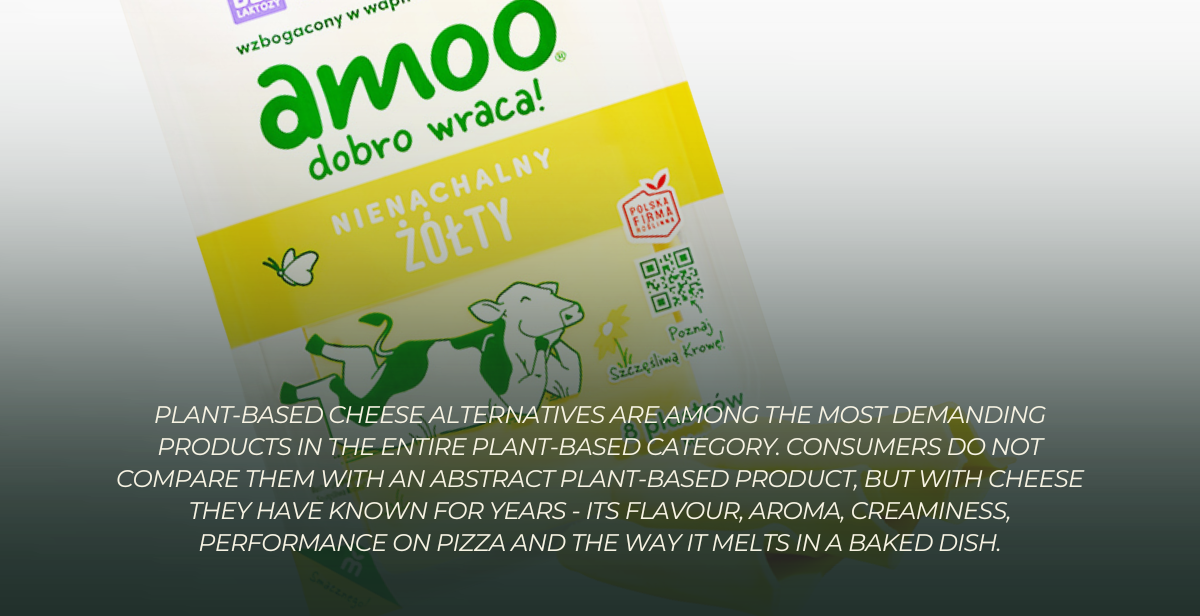
Plant-based cheese alternatives are among the most demanding products in the entire plant-based category. Consumers do not compare them with an abstract plant-based product, but with cheese they have known for years – its flavour, aroma, creaminess, performance on pizza and the way it melts in a baked dish.
That is why, in this category, a well-composed ingredient list is not enough. The formulation must meet several expectations at once: taste appealing, have the right structure, remain stable during production and storage, and, in selected applications, melt, stretch and brown under heat.
Why are plant-based cheese alternatives such a demanding category?
Dairy cheese owes its properties to the natural interaction of proteins, fat, water, salt, fermentation cultures and ageing processes. In a plant-based product, this complex structure must be designed from the ground up.
A sliced product will behave differently from a spread, feta for salads, mozzarella for pizza or a cheese sauce for ready meals. Each of these categories requires a different balance of fat, protein, starch, fibre, hydrocolloids, flavourings and water.
The greatest challenge is that improving one parameter can worsen another. A formulation with excellent stretch may become too soft after chilling. A product with a cleaner label may have weaker stability. A more intense flavour may mask undesirable notes from the plant base, but at the same time limit the product’s versatility.
Flavour and aroma – how to create a cheese-like profile?
Flavour is the first moment of truth. Consumers expect umami, gentle acidity, saltiness and the distinctive depth associated with ageing or fermentation. Meanwhile, plant bases can bring beany, cereal-like, coconut, bitter or overly sweet notes.
The starting point is choosing the right base. Almonds, cashews, oats, soy, peas, rice and plant oils all create different flavour and texture profiles. The next step is to build layers of flavour through salt, acidity, umami components, yeast extracts, flavourings and – where the product concept allows it – fermentation.
Fermentation can give a product a more complex and less flat character. However, it is not an automatic solution. Time, temperature, microbiology, pH and the process’s impact on product shelf life all need to be controlled. The aim is not to copy every dairy cheese exactly, but to create a profile that works in a specific application and remains enjoyable with regular consumption.
Texture and structure – creaminess, elasticity or crumbliness?
One of the most important formulation decisions is: what function should the product fulfil? A spread should glide smoothly onto bread, a slice should retain its shape and not crack, while a block for grating needs a compact but not rubbery structure.
The sensation of creaminess depends largely on fat and its behaviour at different temperatures. Plant oils and fats need to be selected so that the product is soft enough when chilled, pleasant in the mouth and stable during production. Too much fat can create a waxy sensation, while too little can result in a dry, chalky or overly starchy texture.
Plant proteins, starches, fibres and hydrocolloids also help build structure. Each of these ingredients affects water binding, viscosity, gelation, elasticity and resistance to separation. What matters is not only the ingredient list, but also the proportions, order of addition, process temperature and shear forces during mixing.
Melting, stretch and browning – especially important for pizza
A cheese alternative designed for pizza or baked dishes must do more than taste good when cold. It should melt evenly, integrate with the dish, retain moisture and, at the same time, avoid releasing excess fat or water.
This is one of the most difficult formulation challenges. In dairy cheese, the casein network is among the factors responsible for its distinctive performance. In a plant-based version, a system must be created that softens in a controlled way under heat. A structure that is too strong will remain rigid, while one that is too weak may spread into a fatty or watery layer.
It is also important to test the product in real use. It behaves differently in a pizza oven, a convection oven, a microwave or a frying pan. Temperature, cooking time, dough type, the moisture of toppings and portion thickness can all significantly change the final result.
Protein, fat and starch – the foundation of functionality
Plant proteins can improve nutritional value, support structure and influence mouthfeel. However, not every protein works in every formulation. They differ in solubility, flavour, colour and heat resistance. In products where a light colour and neutral profile are particularly important, even a small change in raw material can be noticeable.
Fat builds richness of flavour and creaminess, but it also matters for melting and emulsion stability. Both the type of fat and its share in the overall formulation should be analysed. The size of fat droplets and the way they are dispersed throughout the product also matter.
Starches help achieve the right viscosity and water binding. However, using too much can lead to a sticky, overly dense texture and a floury impression. A good formulation uses them as a functional tool, not simply as a filler.
Choosing ingredients – from the base to functional components
Developing a cheese alternative should begin with a clear product brief. Is it a premium nut-based product? An affordable pizza mozzarella? A plant-based feta for salads? Or perhaps a sauce for foodservice? The answer affects raw material selection, cost, processing requirements and expectations for the final label.
A formulation can include nut bases, coconut components, plant proteins, starches, fibres, stabilisers, emulsifiers, fermentation cultures and flavour components, among others. Their roles should be clearly defined. Each ingredient should bring a specific benefit: flavour, structure, melting, stability, nutritional value or easier processing.
At the development stage, it is worth deciding which claims matter most to the brand. These may include a short ingredient list, high protein content, soy-free, gluten-free, coconut oil-free or an appropriately low salt content. Such assumptions should guide R&D work from the first trials, rather than being added at the end of the process.
Product stability and shelf life
A good-looking prototype is not always a good commercial product. A cheese alternative should retain its uniformity, colour, aroma and texture throughout its declared shelf life. This requires checking, among other things, the risk of fat separation, surface drying, changes in consistency and the development of undesirable flavour notes.
Stability is influenced by pH, water activity, the pasteurisation process, packaging type, the cold chain and the presence of cultures. In fermented products, the balance between desirable flavour development and the safety and consistency of every batch is particularly important.
Shelf-life tests should include not only laboratory analysis, but also sensory evaluation. A product that still meets microbiological requirements after several weeks may no longer meet consumer expectations for flavour or texture.
Different applications, different definitions of success
There is no single perfect plant-based cheese alternative. A sandwich product should remain fresh and easy to spread. A burger slice must withstand packing, transport and heating. Pizza mozzarella should perform well after baking, while feta for salads should remain firm and distinctive when in contact with dressing or vegetables.
Consistency is equally important in the B2B segment. A producer of pizza, ready meals or sandwiches needs an ingredient that works well in their process, does not disrupt the production line and delivers a predictable result in every batch.
That is why product development should always include tests in the target application. Evaluating the product on its own, in a cup or on a spoon, cannot replace a trial on pizza, in a burger, a baked dish, a spread or a chilled ready meal.
From prototype to a product ready for sale
The best projects develop in stages. First, define the product’s purpose and key function. Then create several formulation variants, test them from both a sensory and technological perspective, and later assess their stability, scalability and cost.
At this stage, close cooperation between R&D, purchasing, production, quality and marketing is particularly important. A formulation may be excellent in the laboratory but difficult to implement at scale or too expensive for the intended price point. Likewise, a product that is attractive from a marketing perspective must genuinely deliver on the promise made to the consumer.
Summary
Plant-based cheese alternatives offer manufacturers enormous opportunities, but they require a precise approach to formulation. Success depends on clearly defining the product’s application, selecting raw materials consciously and testing not only flavour, but also structure, performance under heat and stability throughout the product’s life.
The best formulation does not need to copy every dairy cheese perfectly. Above all, it should create a product consumers want to come back to – because it tastes good, works in their favourite dish and performs as expected every time.
Click and join our newsletter
The best for you
Reach us out
Vegan Stock sp. z o.o.
address:
6, Józefa Marcika Str,
30-443 Kraków, Poland
Tax ID No. PL7352876025