
Seasonal product ideas: summer 2026. How to design products that respond to the rhythm of the warmest season?
Summer has its own dynamics in the food industry. It is not only a period of higher sales for beverages, ice cream or light snacks. It is a moment when consumers’ lifestyles change, and with them the way people eat, shop and evaluate products. The days are longer, we eat outside the home more often, travel more, are more willing to try new things and respond faster to products that meet the need for freshness, lightness and convenience. For R&D teams, this is one of the most interesting moments of the year, because the summer season requires not only creativity, but also very precise technological thinking.
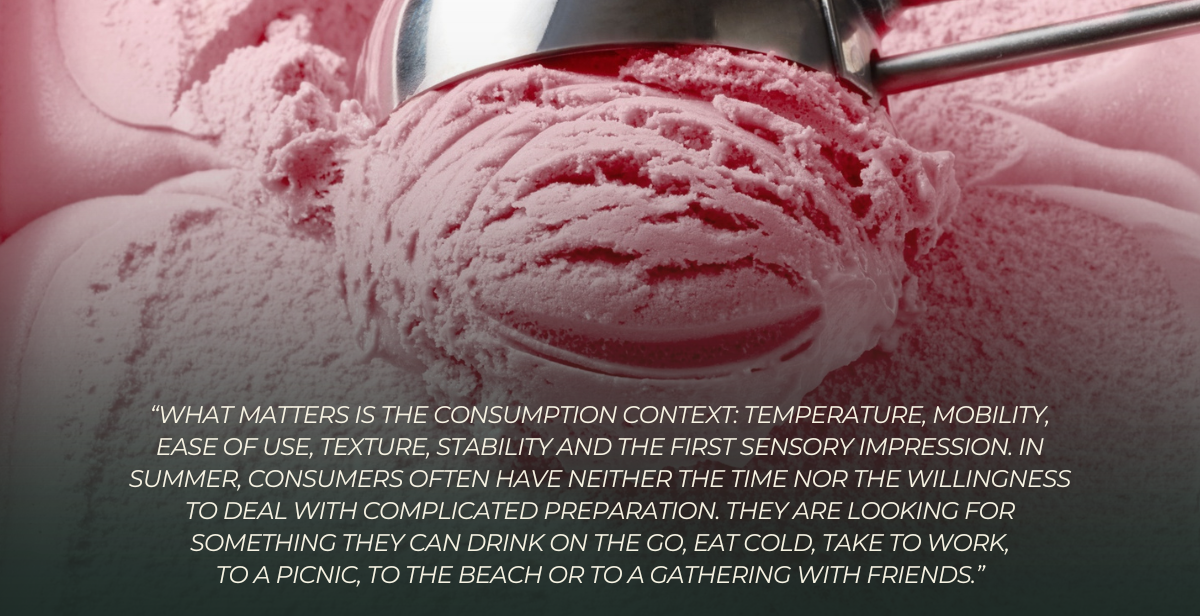
A summer product has to be designed differently from an all-year-round product. In this case, an attractive flavour and a good label are not enough. What matters is the consumption context: temperature, mobility, ease of use, texture, stability and the first sensory impression. In summer, consumers often have neither the time nor the willingness to deal with complicated preparation. They are looking for something they can drink on the go, eat cold, take to work, to a picnic, to the beach or to a gathering with friends. The product should be quick, enjoyable, fresh and intuitive. This is why the summer season strongly favours convenience formats, chilled products, functional beverages, plant-based desserts, dairy-free yogurts, smoothies, light sauces, dips, ready-to-eat bowls, wraps, protein snacks and barbecue solutions.
From an R&D perspective, summer starts not with the question of flavour, but with the consumption occasion. A breakfast product that should be quick and satisfying is designed differently from a dessert that should deliver pleasure without heaviness, and differently again from a beverage that has to be refreshing, stable and well perceived at low temperatures. This may seem like a simple distinction, but in practice it determines the entire architecture of the product. In summer formulations, lightness of texture, a clean flavour profile, the right balance of sweetness and acidity, and stability under less-than-perfect conditions become key.
High temperatures change the perception of a product. What we experience in winter as creamy, rich and comforting may feel too intense in summer. That is why a sense of proportion is so important when designing summer products. Sweetness should be natural and well balanced. Fat should build pleasure and mouthfeel, but not dominate. Texture should be pleasant, but not heavy. Flavour should be clear, but clean and quick to perceive. Fruit, tropical, citrus, berry, coconut, vanilla, tea-inspired or lightly fermented profiles work particularly well in the summer season. Their strength lies in the fact that they can create a feeling of freshness without overcomplicating the recipe.
In plant-based products, summer opens a very broad space for innovation. Plant-based bases are naturally associated with lightness, modernity and functionality, but they require strong technological work. In dairy-free yogurts, it is important to achieve the right creaminess, stability and fresh flavour profile. In protein beverages, solubility, lack of sediment, pleasant texture and neutrality of the base matter. In plant-based desserts, smoothness, stability and the possibility of combining the base with fruit, purees, layers or functional additions are important. In frozen products, the balance between creaminess and lightness after consumption is especially important. Each of these categories can become a strong summer product if it is designed not only for the shelf, but for real-life use.
Ingredients that give technologists predictability play an important role here. Coconut milk powder can be an example of a raw material that fits well into summer product directions, as it allows producers to build creamy, plant-based bases without the need to work with fresh coconut milk. It offers a characteristic coconut profile, convenient dosing, stability and repeatability, which is particularly important in the case of seasonal products. It can be used in dairy-free yogurts, desserts, ice cream, beverages, creams, smoothie bases or foodservice applications. For an R&D team, such an ingredient is not only a flavour addition, but a tool for designing texture and controlling the process.
The same approach is worth applying to plant-based proteins. In summer, high-protein products still have strong potential, but consumers expect a different experience than in classic sports formats. A protein product does not have to be heavy, thick and strongly “functional” in perception. It can be light, chilled, fruity, dessert-like or beverage-based. It can respond to the need for a quick breakfast, a post-workout snack, a light lunch or a convenient way to supplement protein during the day. For R&D, this means working on a formulation in which the nutritional claim does not overshadow the eating experience.
Summer also favours products that combine convenience with a sense of freshness. Ready-made sauces and dips based on plant ingredients can support the barbecue season, snacks and cold dishes. Plant-based spreads fit well into picnics, breakfasts and quick meals. Light convenience meals can draw inspiration from Mediterranean, Asian or Middle Eastern cuisines, as they are naturally associated with vegetables, herbs, fresh sauces and flavours that are expressive but not overwhelming. This is an important direction, because consumers increasingly expect products that are quick but not boring; convenient but high-quality; simple but well developed.
In the summer season, the appearance of the product is also highly important. R&D often focuses on the recipe, but in many categories visual appeal is part of the sensory experience. The colour of fruit, the contrast between layers, the shine of a sauce, the creaminess of the base, the visibility of inclusions, and how the structure behaves after opening all influence the perception of quality. A summer product should look fresh before it is even tasted. This is particularly important in chilled, dessert, breakfast and snack categories, where purchasing decisions are often fast and impulsive.
For producers, it is also important to think of the summer season as part of the annual product development cycle. The best launches do not appear when the temperature starts to rise, but much earlier. The R&D team needs time to select the base, test stability, refine the texture, analyse the recipe cost, check raw material availability and prepare the product for production scale. From the consumer perspective, summer may look spontaneous, but from the producer’s side it should be one of the best-planned periods of the year.
It is also worth remembering that seasonal products can play a much bigger role than simply being a short-term addition to the portfolio. A well-designed summer product can become a test of a new category, a new ingredient or a new way of communicating with B2B customers. It can show which flavour profiles have the greatest potential, how consumers respond to new textures, which formats are easiest to scale and where it is worth developing an all-year-round offer. In this sense, summer is not only a sales season, but also a laboratory for trends.
From Vegan Stock’s perspective, the most interesting projects are precisely those in which seasonality is not decoration, but the starting point for product creation. A summer concept should have a clear function, a well-selected base, a refined texture and a well-thought-out sensory profile. It can be simple, but not accidental. It can be light, but still satisfying. It can be plant-based, functional and clean label, but above all, it has to work well in real use.
The best summer products have something very simple in common: they respond to the rhythm of consumers’ lives. They are easy, fresh, attractive and technologically refined. They do not try to imitate winter products in lighter packaging. They have their own character, their own function and their own consumption moment. That is why summer is one of the most important periods of the year for R&D teams. It is a time to test new ingredients, new formats and new market needs. And if the product is designed well, seasonality can become not a limitation, but the beginning of something much bigger.
Click and join our newsletter
The best for you
Reach us out
Vegan Stock sp. z o.o.
address:
6, Józefa Marcika Str,
30-443 Kraków, Poland
Tax ID No. PL7352876025